

Team Expendable
Dear Forest Green Rovers, axing a women’s team is a choice, not a necessity.

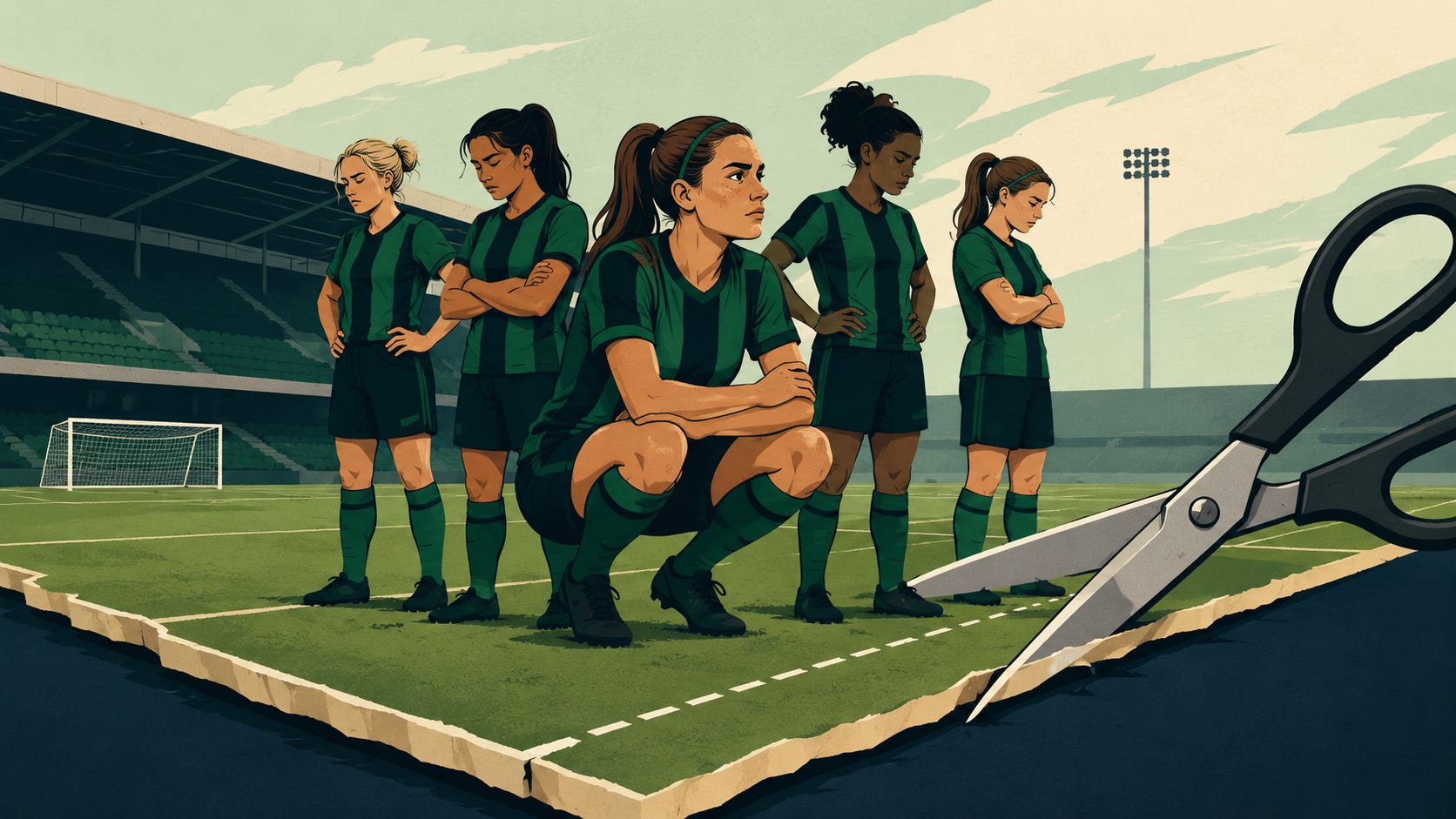
Forest Green Rovers (FGR) have axed their women’s team to support their men’s team.
This is not a headline from the 1980s. The story broke this week.
FGR Chairman, Dale Vince, has hit back at criticism about the club not caring about women’s football by saying:
“FGR have been supporting women’s football for over a decade; the criticism we’ve faced in the last few days for this is entirely misplaced - it’s unfair, in fact.”
I think he’s made it worse.
Does he think FGR should get a pat on the back and a ‘well done’ for supporting women’s football for a bit? Well done, chap, you’ve done your bit.
The reality is that the majority of football clubs struggle financially. This is nothing new. FGR are not special, in that regard.
And yet some clubs manage to have thriving women’s and girls programmes alongside their male counterparts.
I should note at this point, that FGR also cut their boys’ programme to save money, according to Vince, as part of wider cost-cutting to fund the men’s bid to get back into the EFL. I’m not sure if this makes their decision better or worse. Maybe it makes it less discriminatory or maybe it makes it more.
Ultimately, the message says only men’s football matters.
What’s most disappointing is that Forest Green Rovers have a reputation as a progressive club. Their policies and actions with regards to sustainability are second to none.
For me, all those good vibes have been wiped away with one single decision.
Because what their decision says is: the women’s team is optional because we need to ‘concentrate our resources’ on the men’s team.
Ultimately, the message says only men’s football matters.
Success didn’t save them
For some background context, Forest Green Rovers Women played in the fifth tier of the pyramid and finished second in the league last season, an agonising one point from promotion to tier 4 - the FAWNL. They’d had their best season ever - including a decent FA Cup run.
The men were relegated to the fifth tier - one below League Two - in 2024. They finished seventh last season and missed out on promotion via the play-offs. The club’s argument is they need all their money to get the men back into the EFL.
The women had not failed. They had not become irrelevant. They had just had their best season.
But success didn’t save them.
I wish this was an isolated case.
Plymouth Argyle: another best-ever season, another cut
Plymouth Argyle Women have a similar story to tell. Having had their best season ever they finished the season devastated too.
Argyle missed out on promotion to WSL2 in the play-off final and were runners up in the FAWNL Cup final. They were a whisker away from promotion and silverware.
They were sent an email saying that all bar one of them - who had another year on her contract and couldn’t be let go - wouldn’t be part of the team going forward.
The decision, again, was financial and because many women’s players only have a one-year contract, it’s all too easy for clubs to ditch them.
Ultimately, both Forest Green and Argyle have eliminated or damaged their women’s teams after they’d had strong seasons on the pitch, while the men’s teams had failed to meet their own targets.
At Argyle, that price was framed as the unexpected cost of success. At Forest Green, it was framed as the cost of getting the men back to the EFL.
Neither excuse should be accepted.

Do the finances add up?
Forest Green Rovers had a parachute payment when they were relegated in 2024. Having failed to win promotion back to the EFL, they now lose that chunk of money.
I get that makes finances a lot tighter. It is the norm when relegated though - they’re not special.
Looking at the best guess of finances, Salary Sport estimates that FGR’s highest earning man was on over £200,000 a year for last season. Fourteen more were on over £100,000 ranging from £104k to £192k. There’s nine more on a good wage (over £55k) and a few more on less.
I should point out that these are Salary Sport’s estimates, but they give us a magnitude.
I don’t know how much it costs to run a women’s team at these levels but Plymouth Argyle’s chairman Simon Hallett gave us a good idea in a statement in December 2025.
The statement was actually addressing how poor the men’s team had been and, naturally, someone had thought it appropriate to talk about the cost of the women’s team.
Hallett said:
“The net cost of the women’s club is around £200,000 a year. The club will lose millions of pounds this season. Not having a women’s team would not make a meaningful difference to that number, but it would take away something that is part of Argyle’s identity.”
Later the club said they’d had to let all the players go because:
“To get to a cup final and to a playoff game, was a superb achievement, but it came at a cost; a higher financial cost than we had previously thought.”
I’m sorry, what?
It’s too expensive for the women to be successful?
Even accounting for the extra travel expenses for the women’s team, it is still extremely small money in terms of a football club.
For example, two-thirds of that men’s Argyle team reportedly earn over £200,000 per year.
I think in answer to my opening question, the decisions based on finances don’t add up.
Axing a women’s team is a choice, not a necessity. All these stories support that.
It doesn’t have to be this way
Compare FGR and Argyle’s excuses to Lewes FC and these decisions get poorer.
Lewes FC have the same budget for the women’s team as the men’s team. They’ve worked tirelessly to get themselves into the position of being a truly equal club. They’re proof it can be done if there is a drive to do so.
Lewes FC are the flagship for this model but other clubs are now following suit.
So this is not simply a question of whether football clubs can support women’s teams. Some clearly can. It is a question of whether they choose to.
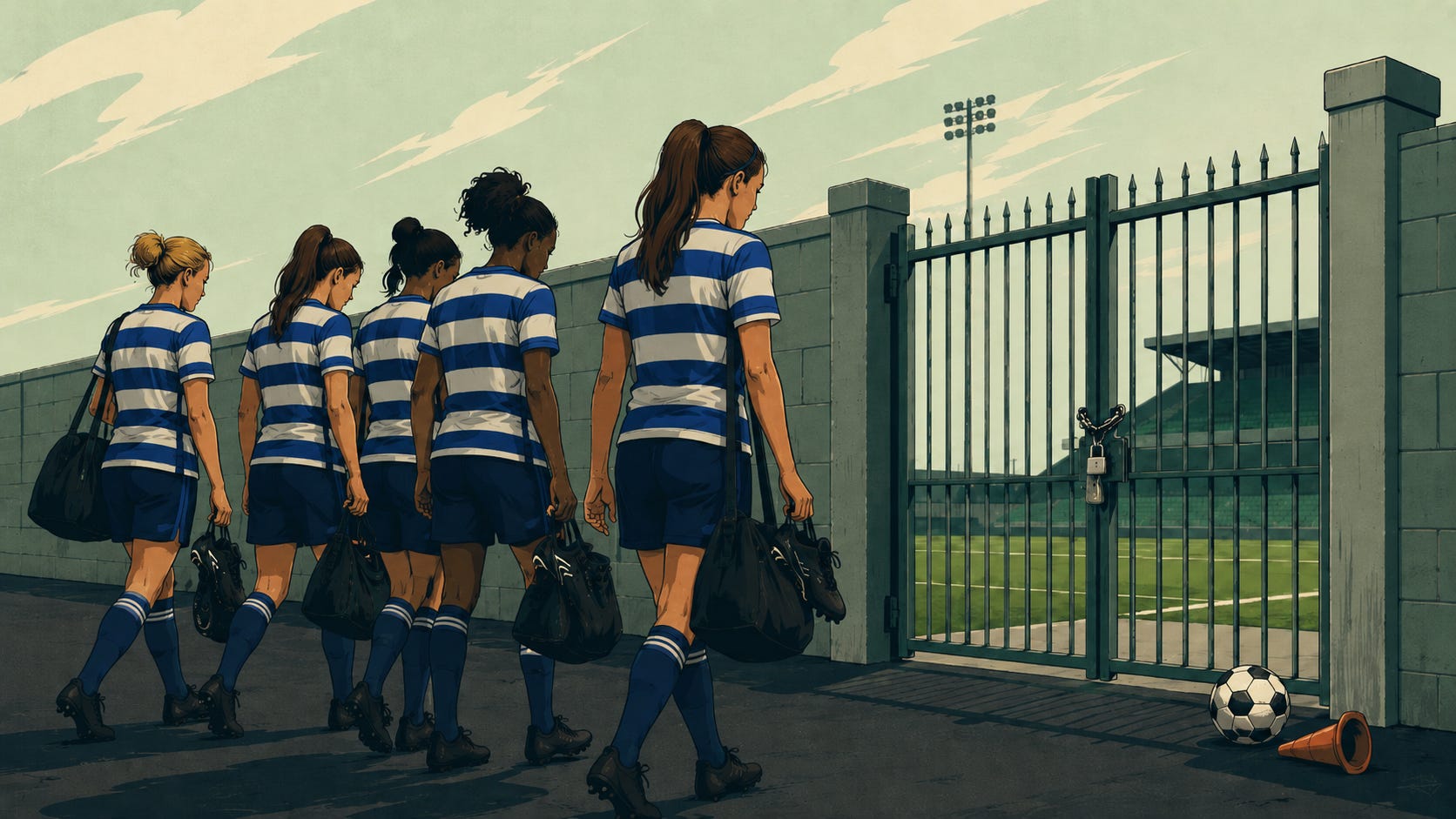
Those who came before
These are not the only two clubs who have been in the headlines for this over recent years.
Thornaby FC
Thornaby FC, a grassroots club, were the first to really hit the headlines for similarly stupid behaviour.
In June 2024, the board decided it was absolutely fine to remove support from the women’s and girls’ section of their club.
More than 100 women and girls lost their football. Six teams were axed.
Again, it was about finances. But this is where other clubs should have learned.
The men’s team front-of-shirt sponsor asked for their logo to be taken off the kit. The sponsor of the women’s side said it would “no longer have any association” with the club.
That is where these clubs are short-sighted.
This is no longer something everyone just accepts.
The club chairman and one other board member had not backed the decision to dismantle the female side of the club but with a strong majority, the decision was made.
Public opinion and major stars like Beth Mead publicly speaking out helped reverse the decision. But only with major changes. The previous board members were removed and a more diverse board took over. Thornaby Women were back.
Call me old fashioned but I think the lessons are clear from this example.
Reading Women
The same summer, Reading Women were withdrawn from the Women’s Championship by the club and had to re-enter the pyramid in tier five. Again, it was all down to finances.
The club couldn’t afford the money needed to meet the increasingly professional requirements of the then Championship (now WSL2) without investment from their owner.
I wonder if this would have been the case had it been the men’s team?
Despite the Lionesses winning the Euros in 2022 and reaching the 2023 World Cup final, women’s football was still not being treated fairly.
The national team could fill stadiums, win trophies, and change the public mood. But at club level, women’s football was still vulnerable to one owner, one spreadsheet, one decision.
Blackburn Rovers
In May 2025, Blackburn Rovers withdrew the women’s team from WSL2 and had to re-enter the league two tiers lower.
Their reasons were much the same as Reading - the investment required to get their infrastructure up to scratch for a full-time model.
Player Rachel Dugdale spoke out after the decision, highlighting some of the financial details. WSL2 included a minimum salary for players. At her age, that would have been £27,000 - the previous season, she’d been on £15,000. Compared with some of her teammates, Dugdale was well paid.
Dugdale told The Guardian in June 2025 that the women’s team budget had been £100,000. This was expected to have to rise to £500-600k in order to meet the criteria. To add some context, the men’s team budget was thought to be £45m.

Wolves Women
Wolverhampton Wanderers didn’t go as far as removing their women’s team from a league but they did block their promotion chances.
At the end of the 2024/25 season, Wolves Women were battling for promotion to WSL2. It was a tight race, coming down to the final day.
Wolves finished second to Nottingham Forest. Had they won promotion, they wouldn’t have been able to play in Tier 2 anyway.
The club had not applied for a licence for the team to play in WSL2.
Again, it was about money.
As with other clubs, promotion comes at a cost to ensure the standards are increased to an appropriate level for the players. The difference in acceptable standards between the Women’s National League (Tier 3) and the now full-time professional standards expected in WSL2 is big. It requires investment.
Investment in a team that is doing well.
The licence application had to be submitted in February 2025. At that time, chairman Jeff Shi didn’t want to be investing in the women because Wolves men were unsure if they’d avoid relegation from the Premier League.
Once more, the men’s failings were hampering the women’s success.
The Wolves Women players and staff were devastated.
There was a lot of soul searching - could they fight again knowing the club wasn’t behind them?
Promises were made and changes implemented - the team went again.
Ironically - and maybe karmically - Wolves Women won promotion and will be playing in WSL2 next season…whilst the men have been relegated from the Premier League and will also be playing in Tier 2.
Professional standards are not the enemy. Underinvestment is.
There is a difficult point here.
The increasing standards in women’s football are a good thing. Players should have proper medical care, proper contracts, proper facilities, proper staff, proper pay and proper support.
The answer is not to keep women’s football cheap so clubs can tolerate it.
The answer is to ask why so many clubs were allowed to build women’s teams on budgets so tiny that basic professional standards become a crisis.
The women succeed. The standards rise. The bill increases. And the club decides the women are the problem.
They are not.
The problem is years of treating women’s football as a nice extra rather than a core part of the club.

Short-sighted, discriminatory decisions should be punished by the FA
Axing a women’s team is a choice, not a necessity. All these stories support that.
The clubs chose not to fund their women’s teams - diverting instead into the men’s teams.
If the FA are truly interested in equality, they should do something about this. Clubs should be punished - heavily fined, have points docked, or be made ineligible for certain levels of the pyramid - if they don’t sufficiently fund a women’s team.
UEFA club licensing already requires clubs applying for a UEFA licence to support women’s football in some form. That principle should be much stronger across the English game.
The FA should be doing more to help football reach parity. Whilst clubs can get away with this, it seems that many will.
And there is funding available. Both the Premier League and The Football Foundation provide grants. The FA should help clubs access opportunities and support clubs better too. And maybe dip into their own coffers.
When there are clubs striving for parity, and those who have already achieved it, everything else becomes more about discrimination.
Men’s football is still being put above women’s football. Clubs are still broadcasting that boys playing football is more important than girls playing. It’s telling girls and women that the sport still doesn’t value them. And this has much wider implications beyond just a game.
A hundred years ago, the FA banned women from using their facilities because they were worried about the impact on the men’s game.
Has so much really changed?
If today’s news about clubs cutting women’s teams makes your stomach drop, you should read what happened in 1921. It’s the same playbook.
I’ve dropped the price on my PDF pocket history, The 1921 Ban as Cultural Erasure, to £4.99 this week so more people can see the pattern. Use discount code: PATTERN01
Purchase it here →
A fascinating, if slightly depressing read.
I'm amazed male players so far down the pyramid can earn 200k per year. For context, that outstrips what I earned as a firefighter by more than 5 times.
It would appear that what some clubs are doing is running women's teams as some form of virtue signalling - promoting the idea publicly that they care about the women's game but when it comes to it, not backing that up.
The FA absolutely could do more about this.
Brilliant insight into what many people would palm off as ‘money problems’. Thank you for making it clear that this is a choice, not a necessity!